Useful Information
The files provided below include monthly, seasonal and yearly typical load profiles for the following types of consumers:
- Small Industrial
- Small Commercial
- Medium-sized Industrial
- Medium-sized Commercial
- Large Industrial
- Large Commercial
- Residential
-This information is only available in Greek-
Profile Classes in accordance with the Electricity Market Rules Version 2.0.0
The Profile Classes that will be used for the operation of the Competitive Electricity Market are presented below.
The Profile Classes of the Distribution System Users are divided in two main categories based on the behavior of the Network User as shown below:
1. Energy Offtake Profile Classes
- Domestic Consumers
- Domestic Consumers with a PV system (Net Metering)
- Small Commercial Consumers
- Large Commercial Consumers (Except Hotel Units)
- Large Commercial Consumers (Hotel Units)
- Small Industrial Consumers
- Large Industrial Consumers
- All Commercial Consumers with a PV System (Net Billing)
- All Industrial Consumers with a PV System (Net Billing)
- Water Pumps
- Thermal Energy Storage
- Public Street Lighting
2. Energy Injection Profile Classes
- PV Systems
- PV Systems on Rooftop
- Wind Parks
- Biomass Systems
The typical consumption/generation profiles of each Profile Class, presented within the documents below were derived from metering data
-This information is only available in Greek-
How to act in case of interruption of electricity to your residence or other premises.
Before you phone EAC:
Check whether neighboring houses have supply.
Check whether you have been handed an advance notice:
-
For either a scheduled interruption of supply which affects you, by means of an EAC form or via an announcement in the press/ radio/TV.
-
or disconnection of your supply for an unpaid bill.
If you have not received such an interruption notice and if you have not noticed a general interruption of supply in you area go to the place where your meter and automatic switch are installed and check whether your automatic switch has operated from position ON or I to position OFF or O.
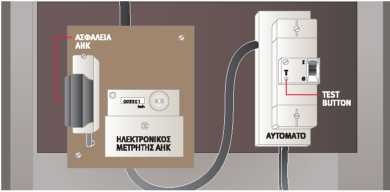
Example of installation of a single-phase service apparatus.
If your automatic switch is in the OFF or O, position try once to switch it to position ON or I.
If it returns to position OFF or O, there is a problem with your electrical installation and you must call a licensed electrician for further action.
Recently EAC started installing adjacent to its meters, Miniature Circuit Breakers (MCBs) instead of the cut- outs known as fuses.
In the case of operation of the MCB of the EAC, a trial for switching it to position ON, can be carried out by the customer. Check whether the MCB of EAC is in the position O. If it is in this position bring it manually to position I in order to restore supply to your premises.
If it returns to position O, then there is some problem with your electrical installation, probably an overloading, and you must call a licensed electrician or, you should remove load by disconnecting some of your electrical appliances. If the overloading problem appears frequently, apply to EAC for an increase in your load, i.e. replacement of your fuse or MCB by one of greater capacity.
ATTENTION:
If there is electricity supply in part of your electrical installation, check the individual MCBs of the Distribution Board, which is installed inside your premises. If you have a problem, call a licensed electrician. EAC cannot be called for problems within the premises beyond its own meter.
For three- phase supplies (e.g. storage heaters installation).
In case of total interruption whatever is mentioned above applies.
In case of partial interruption:
-
Check and bring to position ON or I the MCBs of the Distribution Board which is installed in your premises. If EAC McB’s exist before the meter, check and bring those that had operated from position O to position I.
-
If the problem persists call EAC at telephone number 1800.
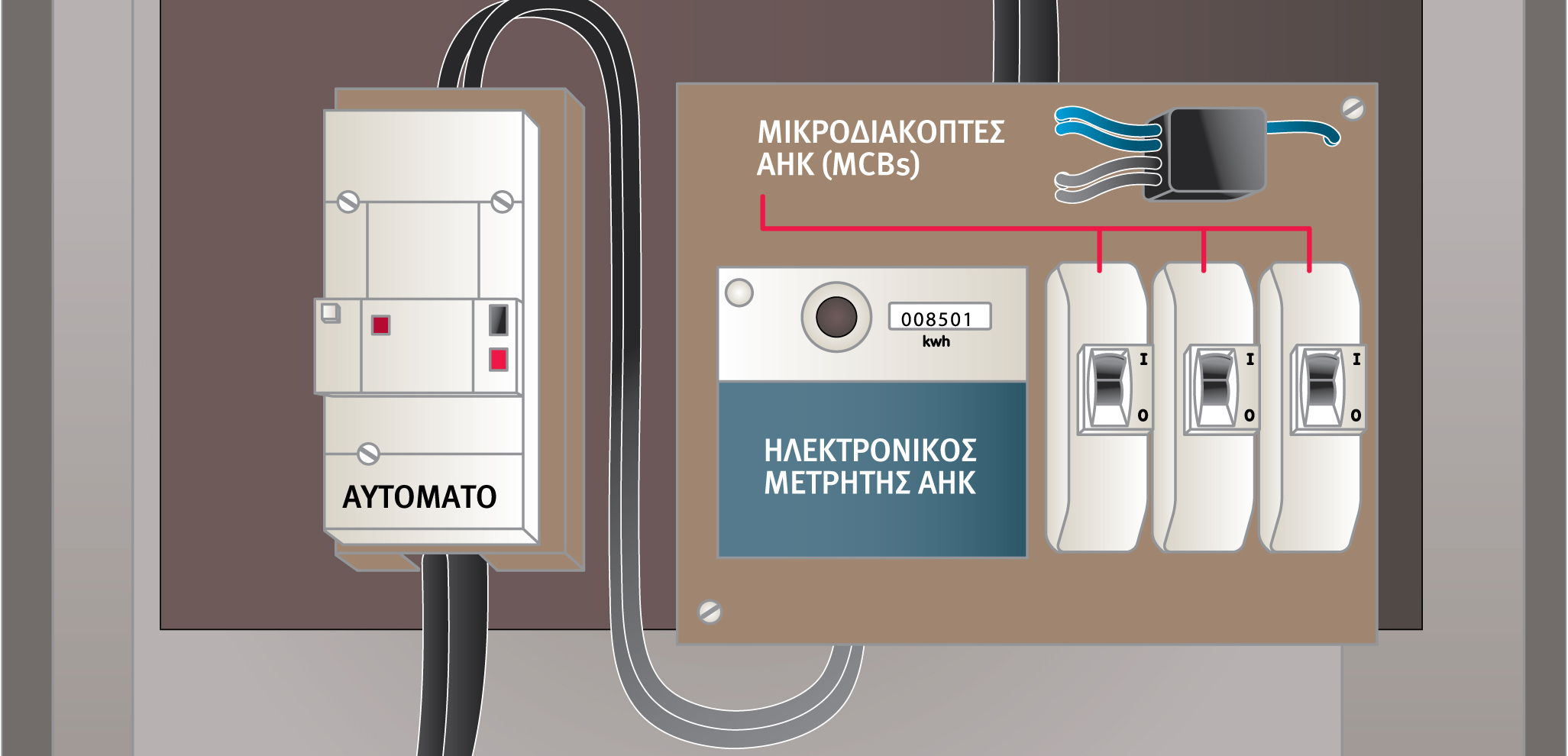
Example of installation of a three – phase service apparatus
Call the EAC Fault Reporting telephone number 1800 for the following cases:
-
If you have no electricity and your automatic switch is in the ON or I position and adjacent to the EAC meter a cut – out (fused) is installed and not an MCB.
-
If you ascertain that there is a general interruption of supply in your area.
-
If you desire further guidance or information or in the event of despite your efforts you are not successful in restoring your electricity supply.
Note. For your best service please ensure that you give us accurate information which will enable EAC employees to locate your premises and the nature of the fault.
Why it is to your benefit to check your automatic switch and/ or the EAC MCB prior to calling EAC.
On many occasions of interruption of your electricity supply this may be due to the operation of the automatic switch.
If you manage to restore the automatic switch or the EAC MCB yourself in the ON or I position you will have the following benefits:
-
Your supply is restored directly and you need not await for the EAC team.
-
You avoid getting charged for the EAC team visit.
General Information
What is the Earth Leakage circuit breaker or the so called “Automatic Switch.”
The Earth Leakage Circuit Breaker “automatic switch” is an electrical apparatus which disconnects the supply of electricity in the event of a leakage to earth or overloading.
The commonest cause for the operation of the automatic switch is a faulty appliance (i.e. the existence of an earth leakage).Thus your automatic switch operates and disconnects the electricity supply in order to protect you from a possible electroshock. Another reason for the automatic switch to operate is the overloading of the installation.
There are various types of automatic switches with minor differences among them. The lever or operation button can be in the position I or O or pushed in or out. Next to it there is a small test button which when depressed interrupts the electricity supply. This button must be periodically tested in order to verify that the automatic switch operates normally and it can protect you in the case of earth leakage should there be a need to do so.
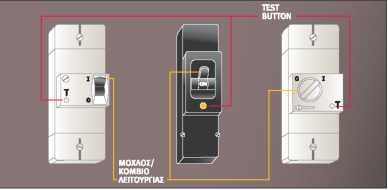
 Example of three different types of automatics switches.
In some installations (factories, old blocks of flats etc) there is no such automatic switch, but a fused switch. In such a case if need be the replacement of fuses must be carried out by a licensed electrician.
Where your automatic switch and the electricity meter of EAC are located.
Usually the (automatic switch) earth leakage circuit breaker is next to the EAC meter. The meter is usually installed in a cabinet on the veranda, the staircase, in a special construction, on a service pole etc.
In certain cases of very old or preserved premises, the automatic switch and the meter can be found within the interior of the premises near the entrance.
In the case of block of flats, meters and automatic switches are usually installed in a special metering room in the basement or in the parking area. The number of each flat, shop or other premises is written underneath each meter or automatic switch or fused switch. In this manner it is very easy to locate your automatic switch or your fused switch. When you purchase a new flat or house make sure that you are informed by the vendor or the electrical contractor on the position of your meter and your automatic switch.
Always follow the above advice diligently. If there is something you do not know do not take risks. Call a licensed electrician to rectify any fault or call the EAC’s Customer Contact Centre at telephone number 1800.
In cases of shortage of power generation, the Transmission System Operator of Cyprus (TSOC), in an effort to balance Electricity Supply and Demand may proceed with controlled Load shedding according to the Load Groups below.
It should be noted that the Groups below may be subject to change if it is demeed to necessary for the purpose of ensuring the safety and reliability of the electrical grid, which is of the utmost priority.
*** The following information is only available in Greek***
Technical Guides
You can read various technical manuals relating to smart meters, lightning protection, and surge protection for rooftop photovoltaic installations and outdoor photovoltaic installations below:
Service Charges
You can find the table of the new charging policy as well as the charges for the services offered below:
You can find Information regarding Connection Terms Payment below:
DSO Announcement – Payment of Connection Terms and other services
You can read information regarding Electromagnetic fields below:

